What Wavelength Is Best for a UV LED Nail Lamp?
The best wavelength for a UV LED nail lamp is a dual-wavelength combination, typically 365nm and 405nm. This configuration ensures broad compatibility across different gel polish formulas. Many buyers focus entirely on wattage, but wavelength actually dictates whether the chemical curing process occurs successfully.
Understanding Nail Lamp Wavelengths
When professionals evaluate a UV LED nail lamp, the light spectrum matters most. Ultraviolet light operates on different frequencies measured in nanometers (nm). Traditional fluorescent UV tubes primarily emitted light around the 365nm range. Modern LED technology shifted toward the 405nm range to achieve faster curing times.
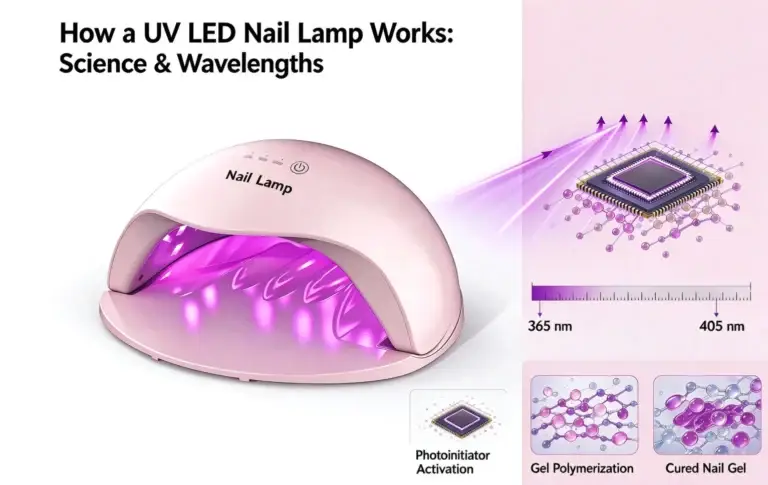
Today, manufacturers engineer dual-wavelength devices to maximize performance. These hybrid units feature advanced diodes that emit both 365nm and 405nm simultaneously. This technological advancement bridges the gap between older UV-curable systems and modern LED-specific gels.
How The System Works: The Science of Photoinitiators
Gel polish curing relies on a precise chemical reaction called polymerization. Gel formulas contain light-sensitive molecules known as photoinitiators. You can think of the photoinitiator as a lock, and the specific light wavelength as the key.
-
365nm (UV-A): This deeper wavelength penetrates thick layers effectively. It works exceptionally well for traditional builder gels and targets the bottom layers of the polish.
-
405nm (Visible Violet): This shorter wavelength delivers a rapid surface cure. It stabilizes color quickly and activates modern LED gel systems.
If a technician tries to cure a 365nm-sensitive gel with a 405nm-only lamp, the light simply passes through without triggering the reaction. The gel remains soft and structurally weak.
Key Features: Interpreting Device Specifications
Navigating marketing terms easily confuses salon operators and distributors. You cannot rely on a single wavelength number to determine if a lamp will cure every gel on the market.
To read device specifications correctly, evaluate these factors:
-
Dual-Spectrum Labeling: Look for explicit mentions of 365nm + 405nm output to guarantee versatility.
-
Diode Configuration: Ensure the internal architecture distributes both wavelengths evenly across the curing chamber.
-
Actual Irradiance: Wattage measures electrical power consumption, not optical UV output. Higher wattage does not guarantee a complete cure.
A lamp specifying a narrow 405nm band will struggle with gels requiring 365nm absorption. Professionals must verify the exact spectral output listed in the technical manual.
Business Impact: Why Compatibility Matters for Salon Owners
Investing in the wrong UV LED nail lamp directly impacts salon profitability and client safety. Mismatched wavelengths lead to severe application failures and negative customer experiences.
Common issues caused by wavelength incompatibility include:
-
Wrinkling: The surface cures instantly under 405nm, while the lower layers remain wet because the lamp lacks sufficient 365nm output.
-
Lifting: Undercured gel fails to bond with the natural nail plate, causing premature peeling.
-
Allergic Reactions: Prolonged skin exposure to uncured monomer significantly increases the risk of contact dermatitis.
Eliminating these risks requires business owners to prioritize technical compatibility over aesthetic design or unverified marketing claims.
Following Manufacturer Guidelines for Future Success
The nail industry continues to develop complex chemical formulas. As gel chemistry evolves, light curing technology must adapt accordingly.
The most reliable strategy involves checking the compatibility data provided by both the gel manufacturer and the device manufacturer. Always verify that your UV LED nail lamp emits the exact wavelengths required by your chosen chemical system. Taking this analytical approach guarantees consistent results, protects client health, and optimizes salon efficiency.
FAQ
-
Does a higher wattage mean better curing?
Wattage measures electrical consumption, not optical curing power. A high-wattage lamp with the wrong wavelength will still fail to cure gel polish correctly. You must prioritize the correct nanometer output over raw electrical power. -
Can a single wavelength cure all gel polishes?
No. A single wavelength cannot cure all gel formulas on the market. Different gels contain different photoinitiators that require specific light frequencies, which is why dual-wavelength lamps offer much better compatibility. -
What happens if the lamp wavelength does not match the gel?
The gel will experience undercuring if the wavelengths do not match. This mismatch causes surface wrinkling, poor adhesion, premature peeling, and potential skin allergies from exposure to wet monomer. -
What are the 365nm and 405nm wavelengths used for?
The 365nm wavelength penetrates deeply to cure traditional UV gels and thick builder gels. The 405nm wavelength cures the top surface quickly and activates modern LED-specific gel formulas. -
How do I know if my UV LED nail lamp is compatible?
You should review the technical specifications of your lamp and the requirements of your gel polish. Ensure your device emits the specific nanometer range that your gel manufacturer recommends for full polymerization.