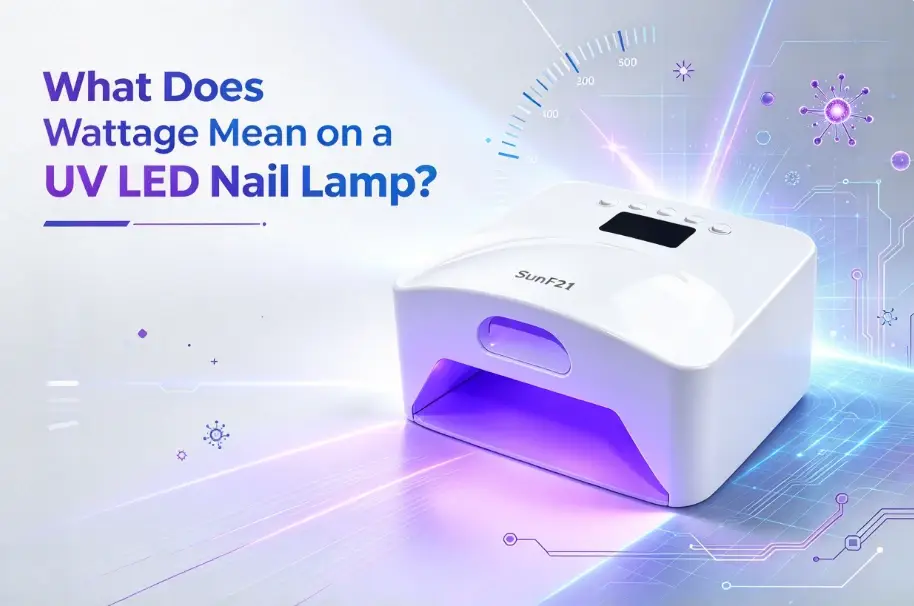
What Does Wattage Mean on a UV LED Nail Lamp?
Many nail technicians and enthusiasts look at wattage as the ultimate measure of a UV LED nail lamp’s quality. They often assume that an 80W or 120W lamp will cure gel polish faster and better than a 36W or 48W model. However, this is one of the biggest misconceptions in the nail industry.
Wattage does not measure curing performance. Judging a nail lamp solely by its wattage can lead to under-cured gels, poor adhesion, and potential client allergies. This article explains what wattage actually means and guides you through the metrics that truly determine curing power.
What Exactly Is Wattage?
Wattage simply measures the amount of electrical power a nail lamp draws from the wall outlet. It indicates electricity consumption, not light output.
When you see a high wattage number on a cheap UV LED nail lamp, it often means the device uses less efficient bulbs. These inefficient diodes consume a lot of electricity but convert a large portion of that energy into wasted heat and visible light, rather than usable curing energy.
A well-designed 36W professional lamp with high-efficiency diodes can easily outperform a poorly constructed 120W budget lamp. The lower-wattage professional unit focuses its energy precisely on the UV spectrum needed to harden gel polish.
Rated Power vs. Actual Light Output
To understand a lamp’s true capabilities, you must separate rated electrical power from actual light output.
Understanding Irradiance
Irradiance is the metric that professionals evaluate. It measures the concentration of UV energy that actually reaches the nail surface, usually expressed in milliwatts per square centimeter (mW/cm²).
While wattage pulls power into the machine, irradiance pushes curing energy into the gel. Two lamps with the identical 48W rating can deliver completely different irradiance levels based on their internal engineering and diode quality.
The Danger of Misjudging Power
If you rely on wattage and end up with low irradiance, your gel might look hard on the outside but remain gooey on the inside. This improper curing causes the gel to lift prematurely. Furthermore, uncured monomers trapped near the nail bed can trigger severe skin sensitivities over time.
Crucial Factors Beyond Wattage
Since wattage cannot guarantee a perfect cure, you need to evaluate other technical specifications.
-
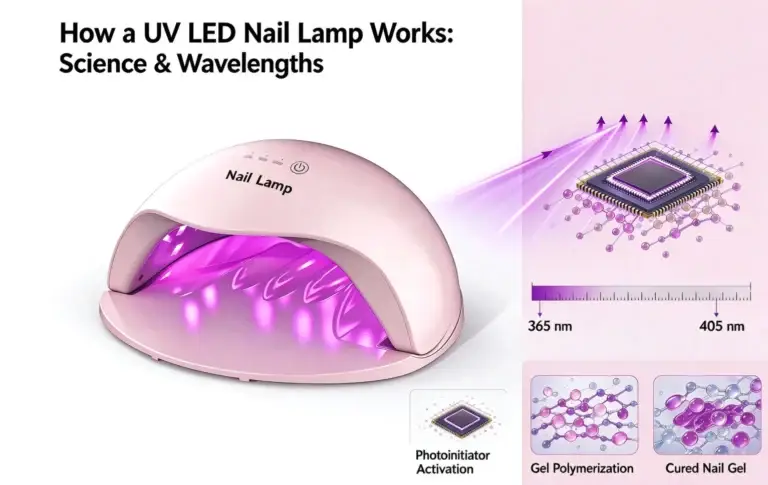
Wavelength Range: Gel polishes contain photo-initiators that activate at specific light frequencies. Most modern gels require a combination of 365nm (for deep penetration and base adhesion) and 405nm (for fast surface curing and high shine). A quality lamp emits both wavelengths simultaneously.
-
Light Distribution: A lamp needs evenly spaced diodes. If a device has high irradiance in the center but blind spots near the sides, it will fail to cure the thumb and pinky nails properly. Strategic bead placement matters more than the total number of beads.
-
Gel Compatibility: Not all lamps cure all gels. Manufacturers formulate their gel systems to react to specific UV intensities and wavelengths. Testing your specific gel system with the lamp remains the most reliable way to verify compatibility.
How to Read UV LED Nail Lamp Specs
When reviewing product specification sheets, ignore the flashy marketing numbers. Use this comparison structure to evaluate your options:
| Specification | What It Measures | Importance for Curing |
| Wattage | Electrical consumption | Low. Only indicates power draw, not UV output. |
| Irradiance (mW/cm²) | Usable UV intensity hitting the nail | High. Determines how effectively the gel polymerizes. |
| Nanometers (nm) | Wavelength compatibility | Critical. Must match the photo-initiators in your gel. |
| Diode Count & Placement | Light coverage | High. Prevents blind spots on the thumb and edges. |
Stop buying nail lamps based on electricity consumption. Focus on irradiance, wavelength ranges, and physical diode layout to ensure a strong, durable, and safe gel manicure.
FAQ
-
Does a higher wattage nail lamp cure gel polish faster?
No, higher wattage does not guarantee a faster cure. Wattage measures electricity used, not UV output. A high-wattage lamp with poor diodes may actually cure slower or less effectively than a highly efficient lower-wattage lamp. -
What is the best wattage for a UV LED nail lamp?
There is no single optimal wattage. Most professional-grade lamps operate efficiently between 36W and 48W. Instead of seeking a specific wattage, look for a lamp that offers dual wavelengths (365nm + 405nm) and adequate irradiance. -
Why is my gel polish peeling even with a high-wattage lamp?
Peeling often results from under-curing. If your lamp lacks the correct wavelength or has poor irradiance, the gel will not polymerize completely. The surface may harden, but the base layers remain soft, causing the polish to lift. -
Can I use any UV LED lamp with my gel polish?
You should verify compatibility before curing. Different gel brands use different photo-initiators that require specific light wavelengths to cure. Matching your lamp’s wavelength specifications with your gel brand’s requirements ensures a proper cure. -
How do I know if my nail lamp is powerful enough?
The most reliable method involves testing the curing performance. Apply a normal coat of gel to a tip, cure it for the recommended time, and wipe it with cleanser. If the color transfers or the gel feels rubbery, the lamp is not delivering sufficient curing energy.